Blades and edges
How Many Times Can a Knife Be Sharpened Before It Is Worn Out?
A full reprofile takes about 0.2 mm off the width of a blade. A touch up on a fine stone takes almost nothing. The difference decides everything.
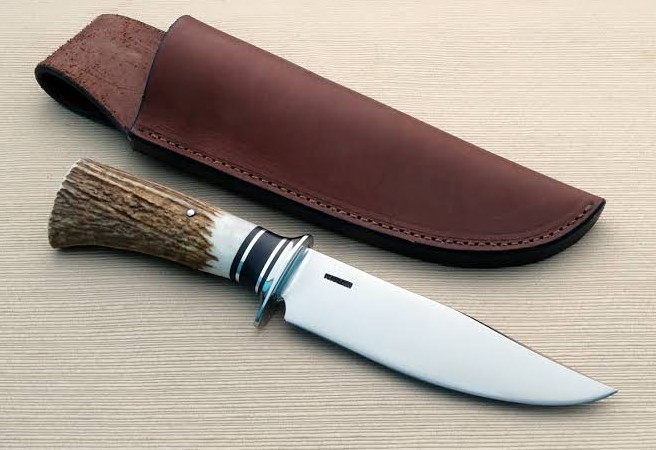
How Much Steel Does Sharpening Actually Remove?
Far less than people fear, and almost all of it in one operation. Routine maintenance removes a few microns. A full reprofile removes around 0.2 mm of blade width.
I started measuring because customers kept asking me to go easy, as though the stone were eating their knife. So for four years I put a caliper on blades before and after, at the same point, an inch back from the tip. The pattern held across every kind of steel that came through the van.
Maintenance sharpening on a fine stone, the kind you do when the edge stops biting, is genuinely negligible. You would need hundreds of those to show up on a caliper. The reprofile is different work: you are resetting the whole bevel because the edge has gone thick and rounded from many small sharpenings, and that means removing everything above the new apex.
Touch Up Against Reprofile
One takes five minutes and removes microns. The other takes half an hour and moves the geometry. Confusing them is why people either sharpen far too rarely or ruin a blade in a year.
A working knife wants roughly one reprofile a year and as many touch ups as it takes to stay sharp between them. Touch up more, not less. The mistake that actually costs blade width is letting an edge go dull for months and then grinding the damage out, because the grinding is now doing a year of avoided work in one session.
| Operation | What it does | Steel removed per pass | How often on a working knife |
|---|---|---|---|
| Strop or ceramic rod | Realigns a rolled edge | Effectively none | Every few uses |
| Fine stone touch up | Restores the apex | A few microns | Monthly in season |
| Coarse stone touch up | Recovers a neglected edge | 0.01 to 0.03 mm | Two or three times a year |
| Full reprofile | Resets the whole bevel | About 0.2 mm of blade width | Once a year |
| Repairing a chip | Grinds past the damage | 0.3 to 1.0 mm, depending on the chip | Only when something went wrong |
Expert note from Lowell Trask, editor, boots and leather
Ezra showed me his numbers and I recognised them immediately. It is the same shape as a resole. The routine job takes almost nothing and can be repeated. The job you do because you let it go too far takes real material, and you only get a few of those. In both trades the customer who comes in often spends less and keeps the object longer.
The Seven Season Blade, Measured
One carbon steel fixed blade in the log, bought in 2019. Original width at the measuring point 31.4 mm, current width 30.1 mm. Seven seasons, seven reprofiles, one chip repair.
That is 1.3 mm gone in seven years, and 0.4 mm of it came from a single afternoon in 2021 when the tip caught a staple in a pallet and took a chip about 2 mm deep. Six years of ordinary annual maintenance cost less than one accident.
Where does that leave it? A blade is generally finished when it has lost roughly a third of its original width, because by then the grind has moved into thicker stock and the knife starts behaving like a wedge. On this one, a third would be 10.5 mm. At the current rate of about 0.13 mm a year excluding accidents, that is a long way off. Realistically the handle will need replacing twice before the blade runs out, which is a strange thing to be able to say about a tool you use every week.
When Is a Blade Finished?
When the geometry stops working, not when the steel runs out. Those are different moments and the first one arrives much earlier.
- The grind has climbed into thick stock. The knife still takes an edge and still will not cut, because behind the apex it is now a wedge. This is the real end point for most blades.
- The bevel is wider than the flat above it. A visual check that costs nothing and tells you the reprofile count is getting high.
- The tip has been reshaped past recognition. Repeated tip repairs shorten and blunt the profile until the knife will not do fine work.
- Roughly a third of original width is gone. The number to check with a caliper before you spend money on a rehandle.
Under the Loupe
Four things four years of measuring changed my mind about.
- Hardness matters less than habit. A hard blade resists the stone, so people push harder and grind longer, and the two effects largely cancel. Across the range I see, from about 56 to 62 on the Rockwell C scale, the gap between two customers was wider than the gap between two steels.
- Powered sharpening is not automatically destructive. A belt run cold and slow removes less than a frustrated half hour on a coarse stone. What ruins blades is heat, and heat comes from pressure and dwell.
- Sheath wear is real and nobody counts it. A blade drawn hundreds of times across a hard sheath edge polishes and thins in a band near the spine. Material leaving the knife with no stone involved.
- Most working knives are nowhere near finished. The seven season blade in our log has lost four percent of its width. People retire knives on a feeling that they have been sharpened a lot, which is not a measurement.
How Do You Slow the Loss?
Four habits, none of which require equipment you do not already have. Together they roughly halve annual width loss.
- Strop before you sharpen. Most dull knives are rolled, not worn, and a rolled edge stands back up without losing anything.
- Touch up early and often on a fine stone. The steel you save is the steel you would have ground away recovering a neglected edge.
- Match the edge angle to the work rather than to a number you read. A blade that rolls on the first bone needs a heavier angle, not more sharpening.
- Keep the tip out of staples, bone and pallet wood. One chip repair costs three years of ordinary maintenance.
Which angle to run, and which steels reward a home stone rather than a trip to somebody like me, is covered in our comparison of which knife steels are worth resharpening at home.
What This Means When You Buy
Buy blade width and a handle that comes off. Those two things set how many decades the knife has in it, and neither shows up in a specification sheet.
A thin blade in a hard steel is delightful for two years and has very little to give back. A knife with real stock behind the grind will accept twenty reprofiles and still cut. Makers who build custom knives one at a time ask what you cut before they choose the stock thickness, and that conversation is worth more than any steel name, because they are sizing the knife to a working life rather than to a catalogue.
The handle half of the question, and what it costs to have one replaced, is in our account of rehandling a knife and what you get back. The same arithmetic applied to footwear is in what it costs to resole boots and when it stops being worth it, and the decision framework for both is on the pillar guide to what can be repaired and when to stop.
Expert note from Marisol Quintanar, textiles and waterproofing
What strikes me about Ezra’s numbers is that the knife is the only thing in our log where routine maintenance is nearly free in material terms. Every time I re-tape a seam or rewax a coat I am adding something that will itself wear out. He is taking a little away and the object gets better. That is a genuinely unusual property and it is why blades keep beating everything else on cost per season.